
With the rise of technology, 140 character tweets and SMS shorthand texts (“BWl! Aamof afaik gonna mari him cuz im in luv wit him!” = “*Bursting with laughter* As a matter of fact, as far as I know I’m going to marry him – because I’m in love with him.”) the English language is under attack. But fear not, we’re going to arm you with 13 of the most deadly and pretentious punctuation marks in the history of the written word, soon enough you’ll be able to come across as a well-educated and well-rounded private school Boffin. Plus you’ll sound cool doing it, how could using a symbol called the ‘Interrobang‽’ not be awesome right?
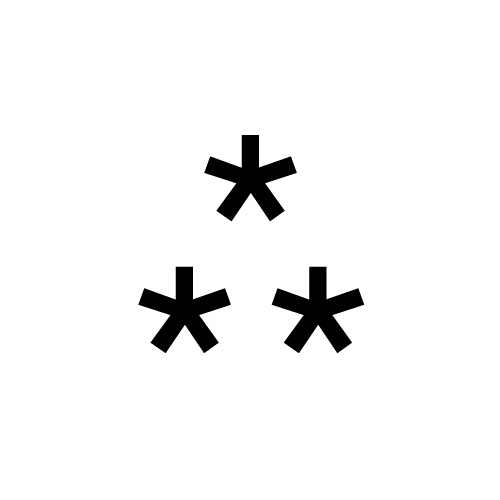
Asterism

Despite it’s epic name ‘Asterism’ and great design, its use is rather underwhelming. It’s designed to indicate when there is a minor break in a link of text. But on a side note, it can also mean “untitled” which lets face it – is also pretty useless.
Dagger

It’s also known as an Obelisk. The Double Dagger is often called the Diesis and both represent a javelin – which is cutting out excess copy from your text. It’s common use though has been to mark out repetitions in poor translations – although in these modern times, it’s most used as a modified footnote.
Solidus

It’s easy to think this is just your typical slash but don’t be fooled. It’s set at a much steeper angle than the commonplace slash for starters and prior to decimalisation taking the world by storm, it was used to separate different values of currency from each other.
Caret

This little symbol actually has 3 other names, it can be called a Wedge, an Up-Arrow and even a Hat. It’s most common name though “Caret” is Latin for “it lacks”, it’s no coincidence either as the Caret is mainly used to highlight that something is missing from the original text.
Guillemets

Name after a 16th Century French printer, Guillemets literally translates into “Little Williams” an interesting and pretty useless fact we have to admit. But their central role is that non-English languages use them as their standard quotation marks.
Sheffer Stroke

Certainly not your everyday symbol – it’s mainly used for Boolean functions Mainly propositional calculus. Which basically means you won’t be using it any time soon – but it’s still a stylish symbol nonetheless.
Becuase

Quite why this symbol means “Because” is somewhat of a mystery – it’s visually very similar to the “Therefore” sign, except it’s inverted.
Section Sign

A favourite of lawyers (who are too good for regular punctuation marks) they use the Section Sign to highlight areas of text.
Exclamation Comma

The best of both worlds right? Simply because you’re excited, doesn’t necessarily mean you have to end the sentence in its tracks.

Interobang

This is one of our favourites – it’s the equivalent of saying OMGWTF? And it’s a combination of the exclamation and question mark fused into one item of pure simplistic greatness.
Pilcrow

If you use Microsoft Word, you’ll have seen this symbol appearing as paragraph breaks – but few people know it’s actually called Pilcrow. The name itself dates back to Ye Olde’ England where it meant “Paragraph”.
Irony Mark

Also called the Percontation Point and the Snark, it’s used to raise awareness of another layer or alternate meaning in a sentence – more often than not an ironic or sarcastic one. Basically it’s a tool which clever people use to make dumb people feel even more stupid – which (in our minds) makes it the best punctuation mark of all!